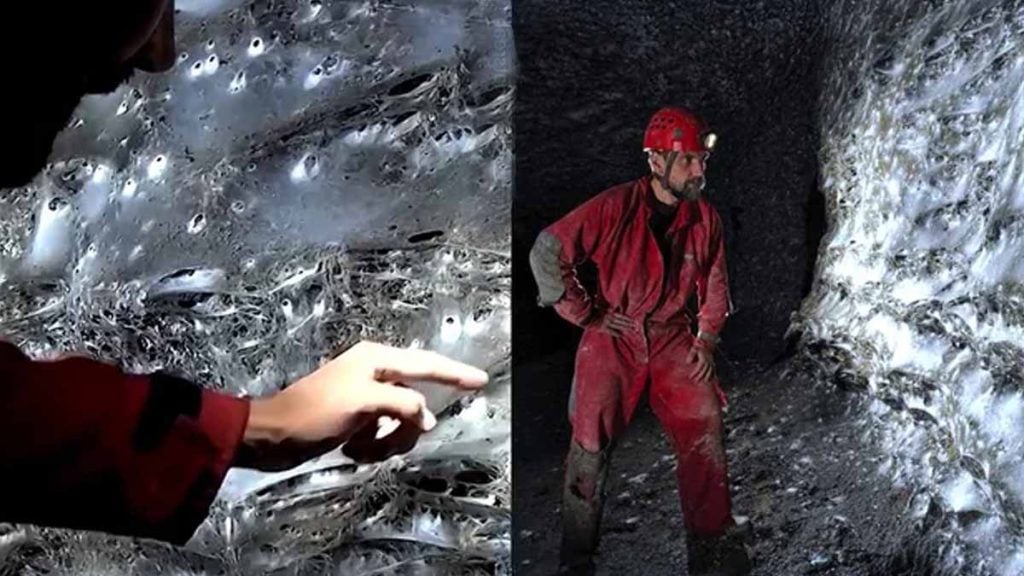
Silk can look weightless, yet this sheet feels alive. It looks like frost, but it moves when you stare. A web covering 106 square metres clings to cave rock in darkness. More than one hundred thousand spiders crowd the same space, and two species share it. That mix should fail, yet it holds. The surprise grows with every step, because the home sits under countries, where a hard border runs overhead.
A border cave where countries share one ecosystem
Sulfur Cave sits on the Albania–Greece border, inside a wider cave system under both lands. Scientists found the web near the entrance, pressed onto the wall. They described the site as a sulphuric cave ecosystem, shaped by sulfur chemistry, damp, cool air, and near-total darkness.
Cavers from the Czech Speleological Society first noticed the web in 2022. An international research team later returned to sample the spiders and map the silk. Their results appeared in Subterranean Biology in October 2025. That paper gave the discovery a solid formal record and clear context.
The measured silk surface reached 106 square meters, which makes it the largest web reported so far. That scale matters for study and protection, because the cave is a single living system. Coordinated care becomes essential when it lies between countries and falls under two sets of oversight.
How a sheet becomes funnel webs
The web is not one smooth blanket stretched across open space. It runs along a narrow, low-ceilinged passage near the cave entrance, where darkness persists. Thousands of small funnel webs merge into one pale layer. The wall looks almost coated in silk and stays quietly busy.
Researchers described the same span in two units. The 106 square meters equal about 1,140 square feet, which helps people picture the size fast. The study also notes the web runs along the passage wall. Shared units also help teams compare records across countries and avoid fuzzy claims.
This patchwork design matches how these spiders live. Each funnel acts like a doorway and a waiting room, ready for a short rush. With funnels packed side by side, movement never stops. That constant traffic makes the colony feel like a city built from silk, not a single trap.
Why countries host a two-species spider city
Scientists estimated around 69,000 domestic house spiders in the colony. The same silk also held about 42,000 Prinerigone vagans, a sheet weaver spider. Together, those counts push the total well past one hundred thousand. Because field teams worked across countries, they could compare counts, photos, and samples carefully.
A shared web woven by multiple spider species had not been documented before in this way. The pairing is even stranger because barn funnel weavers usually prey on smaller spiders. Sheet weavers often fit that size range, so the expected outcome is predation, not tolerance, in most settings.
Inside this cave, the rules seem to bend. Darkness can blunt vision, so hunting cues weaken and mistakes rise. At the same time, food is plentiful, so urgency drops and fights become costly. Under those conditions, both species can feed and settle without constant conflict for now.
Darkness and a sulfur food chain
Scientists linked the spider boom to clouds of tiny midges. These non-biting flies hover near the cave’s entrance zone, then drift along the passage. Spiders catch them in huge numbers, which keeps the web active. Dense living quarters can last easily for months in the dark.
The midges feed on white microbial films inside the cave. Those microbes draw energy from sulfur compounds rather than sunlight, so the system can run in permanent dark. A sulfur-rich stream fed by springs supports this chain. Similar food webs remain rare across countries, even in well-studied regions.
With prey arriving in waves, the colony does not need to spread out. Spiders can tolerate closer neighbors, because each hunt is easier. Dense silk layers can build up over time, rather than breaking apart. That stability helps explain why the record web persists instead of fading quickly.
DNA hints at change, and protection gets tricky
Tests on collected samples added another twist for researchers. DNA work clearly confirmed the Sulfur Cave spiders are genetically distinct from other populations of the same species. Gut analyses also suggested the cave spiders carry less diverse microbiomes than relatives living outside, which tracks their unusual diet.
Isolation can make change much faster than expected. Few newcomers reach a harsh, sealed passage, so traits can concentrate quickly. Diet also stays narrow, because midges dominate the menu for long periods. Over time, selection may favor spiders that cope with darkness, sulfur exposure, and crowded silk.
Protection brings a practical problem. This cave sits on a border, so access and rules can shift by side. Researchers have urged preservation of the colony despite that setting. Long-term care will work best if agencies and scientists coordinate between countries and share joint monitoring plans.
What this record web shows at border lines
A web this large would already be a natural landmark. Yet the deeper story is what it reveals about life in extreme places. The web was first noticed in 2022. Publication followed in October 2025, and the record is now clear. Darkness and a sulfur-driven food chain help explain the crowding. Genetics hints the colony is changing. Border lines complicate decisions, so steady protection will depend on countries treating one cave as one ecosystem.